What does ULTIMATE add to PROFESSIONAL?
ULTIMATE expands the detailed PROFESSIONAL assessment into an enterprise decision and steering blueprint. Depending on the currently purchased scope, this particularly adds a management dashboard, maturity and progress comparison, a broader use-case portfolio, detailed governance and RACI, an employee survey with feedback analysis, KPI control, cost control, a longer-term roadmap and personal expert consultation. ULTIMATE increases depth and manageability, but it does not replace technical implementation or a formal legal, privacy or security audit.
Why does ULTIMATE ask more and more detailed questions?
General expressions of interest are not sufficient for management decisions. ULTIMATE needs information such as process volumes, effort, errors, service quality, roles, systems, data sources, permissions, costs, risks, control requirements, targets and change readiness. These inputs make prioritisation, the business case, target architecture, governance, roadmap and KPI steering more defensible. Unanswered points are shown as data gaps and are not replaced with invented facts.
Which organisations and decisions is ULTIMATE intended for?
ULTIMATE is particularly suitable for organisations that want to compare several departments, processes or possible AI investments and turn them into a controlled programme. Typical decisions concern pilot selection, budget, platform, target architecture, governance, employee involvement, success measurement and scaling. Smaller organisations may also benefit when a decision has high cost, sensitive data, multiple stakeholders or long-term consequences.
Does every ULTIMATE report exactly match the 37-page example report?
No. The example report demonstrates the design, possible chapters and level of detail using illustrative company data. Page count, section depth, recommendations, visuals and calculations depend on the answers provided, uploaded documents, selected processes, available evidence and active product version. Missing findings must not be replaced with generic filler merely to reach the same page count.
Is the ULTIMATE report already a complete implementation project or audit?
No. The report is a detailed blueprint and decision basis. Implementation requires separate planning and execution of technical configuration, interfaces, permissions, testing, migration, operational handover, contracts, security approvals and acceptance. The report also does not replace formal legal advice, a data protection impact assessment, penetration testing or a binding compliance audit.
What does the management dashboard show?
The management dashboard summarises decision-relevant results: maturity, key opportunities, data and confidence status, prioritised actions, risks, responsibilities and modelled time, cost and capacity effects. It supports faster management decisions but does not replace the reasoning and calculation basis in the detailed sections. Example values must be clearly marked as illustrative, while actual values need a source and effective date.
How is AI maturity calculated?
Maturity is assessed across documented dimensions such as strategy, processes, data, technology, security, governance and people. Every component score must refer to specific answers or evidence. Weighting, scale, missing data and the overall formula are disclosed. A value such as 3.0 out of 5 is a structured baseline, not a certification. Later improvement is recognised only when new evidence exists.
What does the confidence rating mean?
Confidence describes how defensible a statement is based on the available evidence. High confidence requires relevant, current and traceable evidence. Lower confidence may result from estimated volumes, missing fully loaded cost, unverified interfaces or unclear regulatory classification. Confidence is not the same as expected benefit: an attractive idea may still have weak supporting data.
How are top opportunities and the pilot process prioritised?
Prioritisation combines value, frequency, standardisation, data readiness, technical feasibility, integration effort, cost, measurability, change effort and risk. ULTIMATE shows component scores, weighting and uncertainty. The recommended pilot should be bounded, measurable, reversible and suitable for human exception handling. Management may select another pilot, but it must be reassessed using the same criteria.
How does the report distinguish facts, assumptions and data gaps?
Confirmed facts include a source, accountable owner and, where possible, an effective date. Assumptions are explicitly labelled as assumptions or model values. Missing or conflicting information appears as a data gap with its reason, impact, responsible role and next collection step. The closing section “What we already know – what still needs to be collected – how ConsuIT can help” summarises this distinction.
How does the 30-/90-/180-day roadmap work?
The roadmap structures delivery into reviewable phases: decide and establish a baseline during the first 30 days, build and test under control by day 90, and stabilise and prepare a scaling decision by day 180. After that, the portfolio, KPIs, risks, training and cost are reassessed quarterly where this service is purchased and operationally established. Dates are target frames and must be adapted to resources, procurement, privacy and technical dependencies.
What do the Start, Test, Pilot and Scale decision gates mean?
Each gate is a control point. Start requires a documented problem, owner, baseline, budget, data and risk. Test requires proven functions, controls, failure paths and training. Pilot requires measured quality, value, cost, security and adoption. Scale requires approved target architecture, TCO, operations, governance and scaling risk. A technically functioning flow alone is not sufficient.
How does KPI and progress comparison work?
Each KPI receives a definition, baseline, target, measurement cycle, data source and accountable role. Typical measures include cycle time, manual effort, errors, exceptions, adoption, cost, security incidents and training completion. Later values may only be compared using the same definition. Management reporting shows actual, target, trend, variance and next action; estimated capacity value remains separate from verified financial savings.
Is the report updated automatically or regularly?
Only when this is technically implemented, included in the purchased scope and supplied with new data. A generated PDF does not change automatically. Recurring analysis requires a defined measurement cycle, new data with source and date, and a new evaluation or report version. The FAQ and user interface must clearly state whether follow-up analyses are included, triggered separately or purchased additionally.
What is included in the ULTIMATE employee survey?
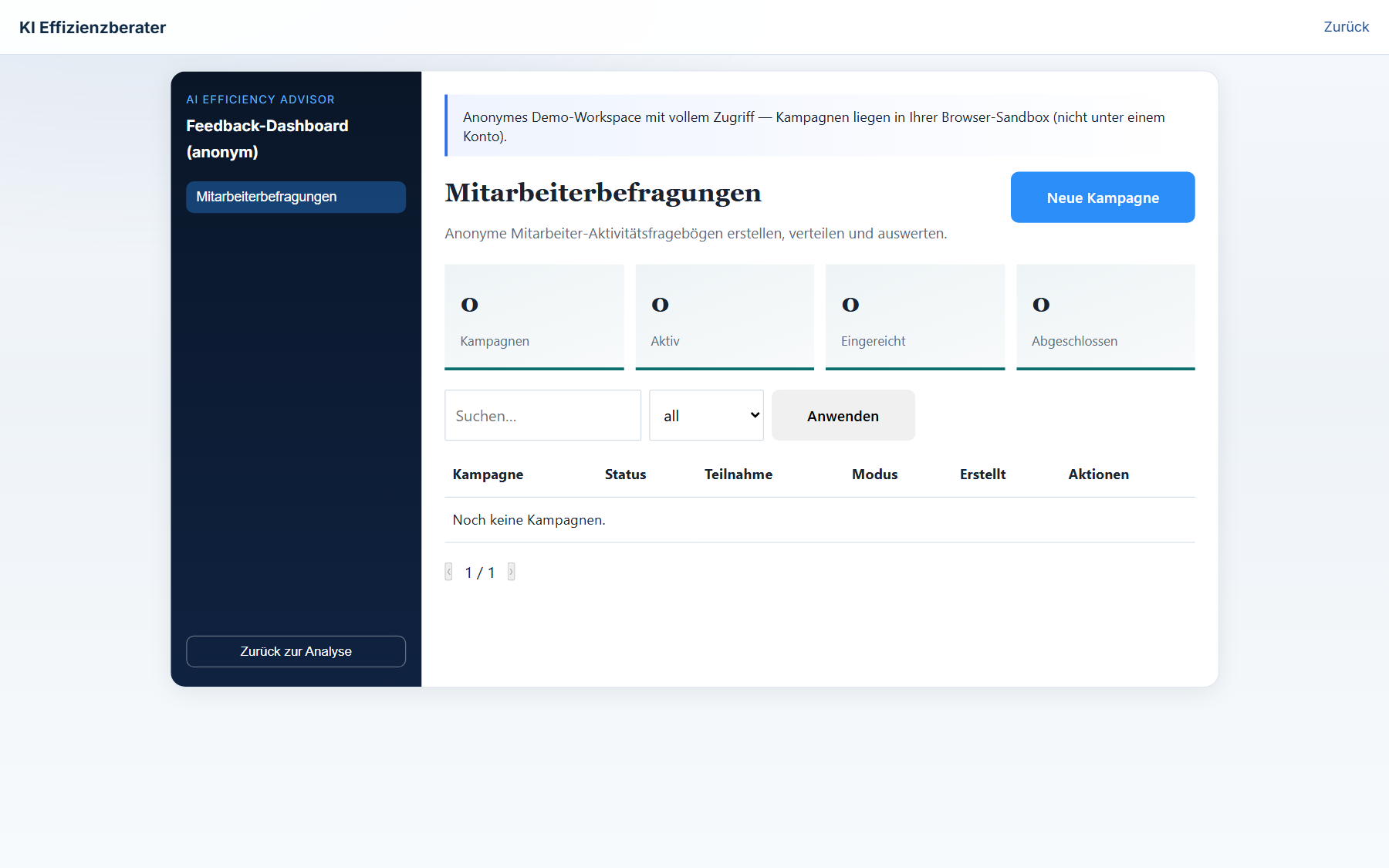
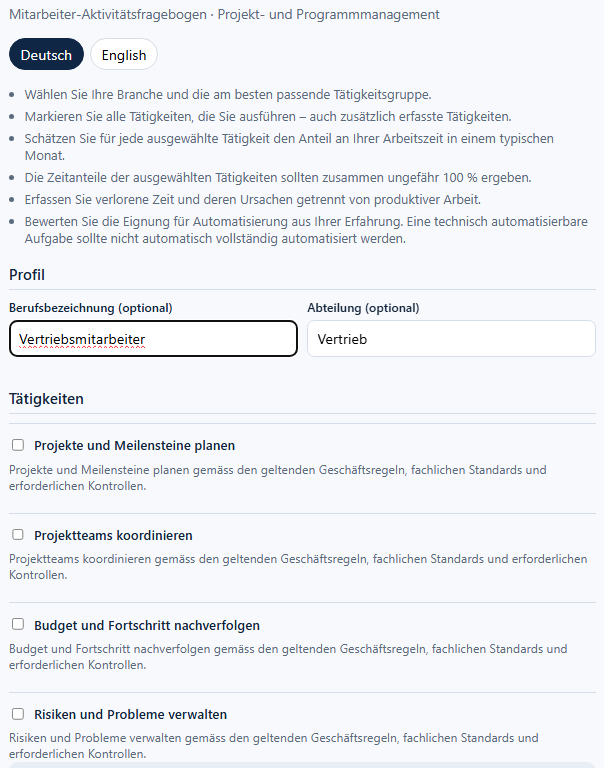
ULTIMATE may include a role- and department-based questionnaire, distribution logic, structured analysis and, where enabled, a feedback dashboard. It can capture recurring activities, time spent, pain points, desired support, required systems, necessary controls and willingness to join a pilot. The currently configured limit and exact feature scope apply; the phrase “up to 2,000” must clearly define what is being counted.
Does every department need a separate questionnaire?
Not necessarily. A shared questionnaire can begin by assigning department and role and then display conditional follow-up questions. This preserves structure and comparability. Separate variants may be appropriate for very different activities, legal conditions or sensitive areas. The choice depends on the analytical purpose, privacy, group size and required level of detail.
How are anonymity and privacy protected in the survey?
Before distribution, the purpose, voluntary nature, collected data, access, retention, analysis and deletion are explained transparently. Results are aggregated where possible. Filters or exports must not identify individuals in small groups, so a configurable minimum group size is required. Free text is screened for personal or sensitive information. Organisational policy and applicable employment and privacy law remain binding.
How does AIEA prevent inappropriate employee monitoring?
The survey evaluates activities, process barriers and support needs, not individual employee performance. Personal rankings, hidden behavioural profiles and individual productivity scoring are excluded. Dashboard filters, role access, exports and retention must technically support this purpose limitation. Employee representatives, HR, privacy and, where appropriate, legal counsel should be involved before real deployment.
What happens if participation is low or unbalanced?
The report shows invitations, responses, participation rate and distribution across permitted groups. Results are not presented as representative when participation is low or heavily skewed. Confidence is reduced and targeted communication, a longer response period or supplementary interviews are proposed. Even with strong participation, employee interest is only one signal; it does not replace a business case, risk analysis or feasibility review.
How do employee responses influence the recommendations?
Aggregated patterns can reveal time-consuming work, process variants, error sources, desired assistance, adoption risks and training needs. They are compared with actual volumes, data readiness, security, cost and feasibility. A frequently requested solution is not automatically recommended. Responses received later do not retroactively change an existing PDF, but may feed into a new analysis or portfolio reassessment.
What is the difference between a dashboard model and the real feedback dashboard?
A dashboard model in the example report demonstrates how metrics and charts could look and may contain simulated data. A real feedback dashboard processes actual permitted responses, applies role and privacy rules, and provides the enabled filters or exports. The FAQ may only promise live access when the dashboard, permissions, data flow, retention and customer access work in production.
How are ROI, TCO and business-case scenarios calculated?
The business case starts with confirmed case volume, minutes per case and fully loaded cost for each affected role. This establishes current effort and a conservatively bounded relief potential. TCO includes at least licences, AI consumption, implementation, integration, security, operations, support, training, human review and exit reserve. Conservative, realistic and favourable scenarios use clearly disclosed realisation rates. The report shows the formula, inputs, source, effective date and uncertainty.
Why are time relief and capacity value not automatically cost savings?
Reduced processing time initially creates capacity. A financial saving only exists when that capacity is demonstrably used productively, enables additional service or revenue, avoids external cost or creates a real cash effect. Implementation, licences, operations, controls and unrealised portions must also be deducted from theoretical capacity value. The report must show theoretical potential, usable value and verified savings separately.
Where do percentages, amounts and maturity values come from?
Every material figure must have a traceable calculation basis. The report states input values, formula, unit, period, source, effective date and any weighting or benchmark. User data, uploaded documents, measured pilot data, external benchmarks and model assumptions are distinguished from each other. Without this provenance, a figure must not be presented as a confirmed company metric.
How do budget limits, alerts and cost control work?
ULTIMATE recommends an approved budget ceiling, accountable recipients, regular consumption review and documented responses to alert levels. For example, trends and forecasts may be reviewed at 50 percent, non-essential use restricted at 80 percent and a safe stop or throttle triggered at 100 percent. Actual thresholds and automation must fit the platform and must not interrupt business-critical work without control.
How are licences, Copilot Studio Credits and Microsoft 365 Copilot considered?
The report reviews the intended use case, existing Microsoft 365 base licences, required Copilot licence, premium connectors and consumption-based credits, messages or tokens. For Microsoft 365 Copilot, it explains, where the supplied information permits, the required base licence and possible monthly and annual cost per user and for the stated employee count. Prices and prerequisites are validated against official sources and a current quotation before a decision.
How does ULTIMATE select an AI or automation platform?
There is no universal winner. The assessment considers the work problem, data, existing platform, integrations, security and compliance requirements, capabilities, operations, scaling, lock-in, cost and internal skills. Depending on the case, Microsoft 365 Copilot, Copilot Studio, Power Automate, Power Apps, Azure AI Foundry, UiPath and other suitable products may be compared. A recommendation states its rationale, alternatives, exclusion criteria and remaining validation steps; vendor preference alone is not a decision criterion.
How deep is the security and privacy review?
ULTIMATE considers identity, least privilege, data sources, classification, DLP, encryption, logging, retention, human approvals, incident handling, supplier risk and safe shutdown, among other topics. The report identifies required controls and missing evidence. It does not confirm technical effectiveness without configuration review and testing, and it does not make a blanket data-location promise. Tenant, contract, platform and region settings must be verified separately.
What do the AI Board, use-case inventory and RACI provide?
The use-case inventory records the purpose, owner, data, value, risk, controls, lifecycle and status of every AI application. The AI Board or an equivalent body prioritises, approves, stops and reviews initiatives. The RACI matrix defines who is responsible, accountable, consulted and informed. The operating model is adapted to organisation size and existing governance; ULTIMATE does not require an unnecessarily large committee.
Does ULTIMATE provide a binding EU AI Act and Responsible AI assessment?
ULTIMATE uses EU AI Act risk principles, NIST AI RMF, Microsoft Responsible AI and other frameworks as structured guidance. It can flag possible risk categories, duties and controls, but it does not provide a legally binding classification. Classification depends on purpose, data, affected people, market, the organisation’s role and actual implementation and must be confirmed by qualified specialists where relevant.
Why might additional readiness or process-analysis tools be recommended?
AIEA provides a broad decision basis. Large or particularly critical programmes may benefit from deeper validation through a Microsoft AI Readiness Assessment, process mining, task mining, workshops or specialist tools such as Famla AI and comparable solutions for process discovery and automation-candidate identification. These are optional next steps, not automatically included services. Purpose, privacy, employee representation, cost and suitability must be reviewed first.
How detailed is the funding analysis?
ULTIMATE assesses possible programmes by country, organisation size, project type, innovation, partners, cost and schedule. For relevant programmes, the report states the responsible body, purpose, funding type or possible amount, requirements, deadline, status, official source and review date. There is no funding commitment. A possible amount is neither deducted from the project budget nor treated as financing until written approval exists.
Which training and change measures are included or recommended?
The report creates a role-based training and change matrix. Business users need safe use and output review, pilot champions need process and feedback knowledge, developers need configuration and error handling, IT and security need operations and controls, and leaders need governance and value steering. Communication, support channels, adoption and evidence of learning are considered. A training discount or specific training is included only when explicitly shown at purchase; a recommendation does not book a service.
What support is included after the report?
The ULTIMATE scope shown at purchase is authoritative. The customer account displays how many report-related email responses, which priority level and which consultation remain available. Email support clarifies the specific assessment but does not replace a workshop, implementation or ongoing managed service. Counts, validity and contact route must come from product configuration rather than only being written into FAQ text.
Does ULTIMATE include a personal 60-minute consultation?
Yes, when the ULTIMATE configuration active at purchase includes this entitlement. In that case, the relevant assessment includes a personal 60-minute session with a qualified ConsuIT specialist. The application must display the booking route, validity, language, format and remaining entitlement. A generally available free, no-obligation introductory appointment is separate and must not be counted as the included expert consultation.
What is clarified during the consultation, and how should the customer prepare?
The proposed agenda is: minutes 0–10 validate goals and report; 10–25 clarify missing process, volume, time and cost data; 25–40 review the pilot, workflow, platform and technical feasibility; 40–50 discuss privacy, security, governance and success criteria; 50–60 record decisions, owners and next steps. The customer should have the report, prioritised questions, current volumes and cost, existing licences and relevant technical or legal constraints ready. Facts already known are not requested again.
Is the report automatically changed after the consultation?
No, not automatically. The session can validate assumptions, clarify data gaps and agree next steps. A corrected or regenerated report version is produced only when this is technically supported and included in the purchased scope or commissioned separately. Changes must be versioned and show which data, assumptions and recommendations changed.
What additional assistance can ConsuIT provide after the assessment and consultation?
Under a separately agreed engagement, ConsuIT may support a discovery workshop, pilot definition, Microsoft 365 or Azure architecture, a Power Automate or Copilot prototype, security and governance design, cost modelling, training or implementation support. Scope, deliverables, effort, price, responsibility and acceptance are agreed in writing before work begins. Purchasing ULTIMATE alone does not commission technical implementation.
Where can I find answers to content-related questions about the report?
The report links to the public general report questions and this ULTIMATE section. A deep link must open the FAQ and move directly to the relevant section without requiring sign-in. If the FAQ does not answer the individual question, the customer can use the email support available for the assessment or the included ULTIMATE consultation. The FAQ explains methodology and terminology but does not replace individual validation of missing company data.
Which statements can I use for a management or investment decision?
Traceably evidenced facts, clearly defined metrics and explicitly approved decision inputs may be used. Assumptions, benchmarks, example prices, modelled scenarios and low-confidence statements remain planning values. Before budget approval or scaling, the real baseline, current quotations, data and security approvals, responsibilities, pilot measurement and stop/go criteria must be confirmed. The report supports the decision; accountable management makes and documents it.